Showing posts with label Food. Show all posts

Tuesday, March 25, 2008

Het brood

Toen ik in Nederland kwam wonen, vond ik het Nederlands brood heerlijk. Vooral Waldkorn was mijn lievelings brood. Zo zacht, zo vierkant, zo donker, zo handig - al gesneden. Met al dat verschillende beleg was voor mij elk ontbijt en/of lunch een echte gebeurtenis. Ik vond het spannend dat ik zo veel verschillende combinaties kon samenstellen.
Dat ging zo ongeveer een jaar. Toen had ik genoeg. Ik had geen zin in al dat verschillende broodbeleg meer. Ik was op zoek naar iets anders en ik kocht elke keer een ander brood. Het hielp niet, want ik wist niet wat ik echt miste.
Daarna gingen wij naar Slovenië op bezoek bij mijn ouders. Bij het ontbijt ontdekte ik wat ik miste in Nederland. Gewoon brood! Dat is geen vierkant brood, maar het heeft een heerlijk korst en grote gaten. De textuur van dat brood is heel anders dan van een Nederlands brood. Het is meer kauwbaar en bevat meer water (denk ik), daarom blijft het ook langer vers.
Terug in Nederland was ik terug bij het eten van Nederlands brood. Maar ik was op zoek naar een oplossing. Brood bakken leek mij altijd heel ingewikkeld. Mijn moeder deed dat nooit en als gevolg daarvan heb ik daar ook helemaal geen kennis over. Ik heb een keer geprobeerd een broodje te bakken meet een broodmix, maar dat mislukte echt.
En toen kwam ik terecht dit recept op het internet. Ik noem dit brood luilakken brood want je hoeft helemaal niets te doen, de tijd doet alles voor je. En bovendien is het zo eenvoudig, dat een kind het zou kunnen doen.

LUILAKKEN BROOD A.K.A NO-KNEAD-BREAD
Ingrediënten:

  • 430g tarwebloem (of een deel tarwebloem en een deel volkorenbloem)
  • ¼ theelepel droge gist
  • 1 ½ theelepel zout
  • 345ml water
  • sesam zaad of pompoenpitten (optioneel)

Meng eerst tarwebloem, droge gist en zout samen. Voeg water toe en roer met een lepel snel totdat alles gemengd is – niet te lang. Doe de folie op de kom of doe de kom in een plastic zak, zodat het deeg niet uitgedroogd wordt. Laat alles staan op de kamertemperatuur voor 12 (tot 18) uur.
Na 12 (of 18) uur, maak wat ruimte op het aanrecht schoon een bestrooi het goed met tarwe. Het deeg is een beetje zacht geworden en zal een beetje plakken aan de bodem van de kom. Neem het deeg uit de kom en leeg het op de tarwe op het aanrecht. Gebruik een lepel om alles uit te krabbelen. Maak de kom schoon met wat warm water en doe er een dun laagje olie binnen (gewoon met wat keukenpapier). Bestrooi het deeg met bloem, trek het rustig een klein beetje uit elkaar en vouw twee uiteinden over elkaar. Draai het deeg een kwartslag en herhaal de handeling.
Bestrooi de bodem van de kom met wat zaadjes en doe het deeg erop. Doe weer de folie erover en laat staan voor 1 tot 3 uur.
Zet een lege bakvorm (ik gebruik een pyrex schaal) met een ovenbestendig deksel in de oven en verwarm alles op de hoogste temperatuur. Het is belangrijk dat het echt goed voorverwarmd is, anders plakt het brood op de bodem van de schaal.
Hier komt het moeilijkste deel van dit recept. Neem het plakkerige deeg uit de kom en gooi het in de hete schaal. Bestrooi met wat sesam zaadjes. Doe de deksel erop en zet alles in de oven. Verwijder de deksel na 30 minuten en bak nog 15 minuten. Neem het brood uit de pan en laat het op een rooster volledig afkoelen voordat je het aansnijdt.

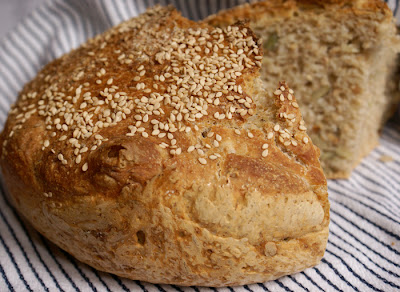
Ik vind dit brood echt heerlijk. Het lijkt op brood dat ik in Slovenië eet. En het is echt makkelijk om te maken. 's Ochtends meng ik alles en 's avonds bak ik. En volgende ochtend eten we lekker zelfgemaakt brood voor ontbijt.
From Food

Op deze afbeelding is brood gemaakt met 2/3 witte tarwebloem en 1/3 volkorenbloem. Er is ook wat pompoenpitten toegevoegd - gewoon samen met de bloem in het begin.

Friday, March 14, 2008

No to violence

I was browsing around and came across this video. I think it has an important message so I decided to publish it here.
I quote the description by the authors:
"You don't hear what we're trying to say to you? Let us show you. Let us write it down for you." That's the general and very simple concept of a videoclip. Shooting took place in Slovenia's capital - Ljubljana, on a city's marketplace. On the left side of a footage there are famous architect Joze Plecnik's pillars, on the right side you can see biggest "mortuary" in the city - closed part of a market, where they sell big quantities of dead animals. Mr. Plecnik was a vegetarian.
Have a look and decide yourself:

It's made by Supersoul connection.

Thursday, October 18, 2007

Bio cultures turning everywhere

That's what happens if you leave right turning cultures out of control. Click on the picture to see it bigger. For more information refer to my previous post about Right turning (bio) cultures.

Wednesday, October 17, 2007

English pie

I watched Nigella Express the other day, a cooking programme on BBC2, where she prepared chicken pie. I was surprised that she is calling something, that is just covered with puff pastry and thrown in the oven for 20 minutes, a pie. Here's a common definition of pie: A baked food composed of a pastry shell filled with fruit, meat, cheese, or other ingredients, and usually, but not always, covered with a pastry crust. I agree with that, you can't call something covered with some puff pastry a pie!
But I thought it might be interesting to try, so I made my own version - off course not filled with chicken. I took some precooked potatoes and cauliflower, and mix them with a sort of bechamel sauce, cheese and spring onions. I covered each model with one sheet of puff pastry and let them bake for 20 minutes at 180ºC. This is what came out.


I will call this an English pie. It looks nice, but the inside part was very very hot because of all the liquid which came out of cauliflower and not very thick bechamel. It was practically boiling! And we were very hungry and wanted to eat it immediately, so that was a real minus for this recipe.

Friday, October 12, 2007

Paksoi lasagne

Here is a simple recipe for a paksoi lasagne for 2 persons. I found it again when tiding up my recipes and remembered that it made a really nice meal. You can replace paksoi with "blitva". I'm sorry - I only know the Slovene name for it. It's very similar to paksoi.

Ingredients:

8-10 sheets of (green) lasagne
1 piece of paksoi
1 onion, chopped into small pieces
a bit of oil
2 tomatos, in slices
100g feta
2 eggs
(optional 100g champignons, in slices)
2dl yoghurt
pepper and salt
oregano
rasped cheese
3 table spoons of bread crumbs


What you need to do, is:
Wash paksoi and chop it into smaller pieces. Heat the oil in a pan and sauté the onion, throw in (the champignons and) the paksoi and let it steam for a few minutes (until the paksoi leaves drop). Crush feta cheese and mix it through the vegetables.
Oil and fill up the lasagne model with layers of vegetable mix and lasangne sheets.
For the topping: mix eggs, yoghurt, half of rasped cheese, oregano, salt and pepper and pour this mixture over the lasagna. Take care that the top layer of lasagne is nicely covered with the topping mixture. Put the slices of tomatoes on top. Mix two spoons of rasped cheese with the breadcrumbs and spread that over it.
Bake at 180ºC for 30-45 minutes.

The topping is what makes this recipe really yummy. Cheese and crumbs make a really nice crust on top. And yoghurt mixture with eggs is a more light option than the creamy one.

Thursday, October 11, 2007

Right turning (bio) cultures

No, this post is not about politics, it's about food and chemistry. I thought I was done with organic chemistry when I finally passed the last exam of study program Graphic arts technology at Faculty of Natural Science and Engineering in Ljubljana, but then I happen to see this on the fridge shelf at a local supermarket: standyoghurt: rechtdraaiend melkzuur, aangezuurd door rechtdraaiende bio-cultures. Translated, right-turning milk acids, made by right-turning bio-cultures.
I have to admit that I find yoghurt in Holland quite different from those which I know from Slovenia. Holland yoghurt is more creamy and it is sold in tetrapak, like milk. The above mentioned standyoghurt was packed in a cup, and I learned that it is different from the other ones. But not because of the right turning milk acids!
There are two different types of yoghurt which differ by the temperature and the duration of the making process:

  • Roeryoghurt, which is more common in the Netherlands, is processed at a lower temperature (32°C) for 10-14 hours. It can be made in big containers (up to 20 cubic meters), where it's also being mixed. Because of that it has a very creamy texture and it's easy to make big quantities and then fill up the tetrapaks.
  • Standyoghurt is a yoghurt known in the rest of Europe. Cups are filled with warm milk and acid cultures and closed. That is then being kept at a temperature of 40-45°C for about 4-6 hours. This yoghurt has more sensitive structure which is destroyed if stirred, that's why it's packed in cups and not tetrapak.
And what do the right turning cultures have to do with this all?
Milk acid is chiral and has two optical isomers.

Optical isomers are substances, known for the ability of turning the polarized light into left or right. Depending on the side of turning, we call them left or right turning substances.

But what does it matter? Left or right turning?
Not much, it doesn't affect the taste nor quality. As a fact, most natural milk acids are right turning. Someone just thought it could attract customers if this is written on a package.

Wednesday, October 10, 2007

Cauliflower and sweet potato curry

You need (for 2 persons):

1 middle size sweet potato
1/2 of a small cauliflower
1/2 or one small onion
a hand full of green beans (sperziebonen)
1 small teaspoon of curry pasta (for example chilly&garlic by Pataks, which is very hot, so in that case take care the small spoon is really a small spoon)
1 teaspoon od garam masala spices powder (available at toko's)
1 teaspoon of vegetable bouillon
1-2 spoons of (olive) oil
2 spoons of cream yogurt
basmati rice for two persons (don't forget to cook that :)

Clean the green beans and cut it into 2-3 cm long pieces. Put it in a pot with some water and vegetable bouillon and bring it to cook for a couple of minutes. In the meantime clean the cauliflower and divide it into small pieces. Peel the sweet potato and cut it into cubes (1-1,5 cm wide). Cut the onion into small cubes.
Take a larger (teflon) pan, heat it up and moisten with oil. Add the onion and fry for a minute or two. Add curry paste and powder, stir so it all divides equally and you can smell the spices. Add cauliflower and sweet potato. Stir around till it all gets covered with curry.
Then take the smaller pot with beans and bouillon and add all together to the bigger pan. Lower the heat, cover the pan and let it simmer for about 15 minutes till sweet potato gets softer. Then, open the pan, higher the heat and let the rest of liquids evaporate. Turn of the fire and after it calms down, mix in 2 table spoons of good cream yogurt.
Serve immediately with basmati rice.

That was today's dinner and we finished it before anyone even thought about taking a photo for the blog. Sorry, maybe next time.

Wednesday, October 3, 2007

Making a mushroom risotto


Some champignons were left after yesterday's salmon champignons quiche, so I decided to use them together with two umbrella-mushrooms (portabella in dutch, marela in slovene) and make a mushroom risotto.
Joop offered to go to the shop to get some more ingredients, including risotto rice. In Holland almost everything comes with a recipe which tells you how you could/should use the product.
This one caught my eye because of the line which suggests serving risotto together with some beefsteak and beans. And as a type of the dish it says a main dish.
So, I am supposed to make this risotto as a main dish and serve it together with beefsteak and some veggies??? Wow! That's real Italian style cooking, oh, yeas! Amazing! Thanks for the tip Lassie!